
Why a Real Video Can Come Back as a Deepfake
Every OriginAI result is a probability. A detector can flag a real video, and it can miss a deepfake. This post explains why both happen, why accuracy changes from one set of videos to another, and how to read a result with that in mind.

You upload a video you recorded yourself, and OriginAI says it's likely a deepfake. You might decide the site is broken, or start to doubt your own video. Most of the time, neither is true. You've run into a false positive: a real video that scored above the detector's line. Every deepfake detector makes this mistake sometimes, ours included, and knowing why helps you decide how much weight a result deserves.
What the score measures
A detector can't know whether a video is fake. It compares the face in your video with the real and fake faces it studied during training and turns that comparison into a score from 0 to 100%. A high score means the face looks more like the deepfakes it learned from. On videos like the ones the detector was tested on, the score works like a probability. On videos unlike them, it's a rougher guess.
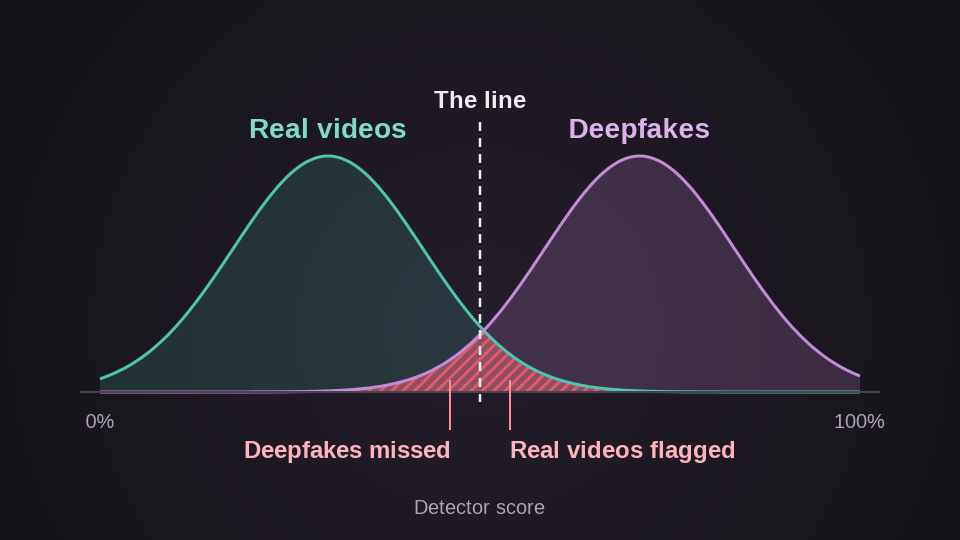
Each detector also has a line, its threshold. From the line up, the result says likely deepfake. Below it, the result says likely real. Real videos and deepfakes don't sort into two clean piles, though. Their scores overlap, as in the picture above, so wherever you put the line, some real videos land above it and some deepfakes land below it. Moving the line trades one mistake for the other. Lower it, and the detector catches more deepfakes but flags more real videos. Raise it, and the reverse happens.
Why real videos get flagged
A false positive usually means your video differs from the real videos the detector studied. These are the most common reasons.
It learned from one collection of videos
Each OriginAI detector learned from one research collection. FaceForensics++, the collection behind Veni HQ and Veni LQ, starts from 1,000 video clips taken from YouTube, picked so that one person's face stays in view and mostly faces the camera. A vertical phone video filmed in a dim bedroom with a beauty filter on looks unlike anything the detector saw labeled as real. When a video falls outside what a detector knows, its score becomes less reliable, and it can land on either side of the line.
Compression and re-uploads
Each time a platform saves a video again, it throws away detail to make the file smaller. Skin turns smooth, edges blur, and blocky patterns appear around the face, the same kinds of traces a face swap can leave. Veni LQ learned from heavily compressed video for this reason, but a clip forwarded through several chat apps can still confuse it.
Filters and edits
Beauty filters, skin smoothing, face reshaping, AI upscaling, and "enhance" buttons all change the face with software, and some of them use the same kind of AI that deepfake tools use. The detector sees a face that software has changed. It can't tell a filter from a face swap, and in a sense it's right: something did change the face.
Hard footage
Low light, motion blur, grain, a face turned to the side, or a hand, hair, or glasses covering part of the face give the detector less to work with. Its moment-by-moment scores get noisier, and a few bad stretches can pull up the score for the whole video.
Shortcuts in the training data
A model learns whatever separates real from fake in its training videos, including clues that have nothing to do with deepfakes, such as small differences in sharpness or compression between the real and fake videos of one collection. Those shortcuts work on that collection's test videos and fail on yours. Researchers call this poor generalization, and it is one of the biggest open problems in deepfake detection.
Why some deepfakes get through
The opposite mistake, a false negative, happens for related reasons. The research collections behind OriginAI's detectors came out in 2019 and 2020, and generative AI has changed a lot since then. Current tools can swap a face live during a video call or move a person's lips to match new audio. Their flaws look different from those of the older face swaps our detectors studied, and a detector can only flag the kinds of traces it has learned. If a new tool leaves none of those traces, its deepfake can pass as real.
Detection also moves slower than generation. Anyone can try a new generator the day it comes out, while collecting and labeling its videos and retraining a detector on them takes months.
Some fakes also fall outside what OriginAI checks. On this site, a deepfake means a real person's face that AI has swapped or altered. A video generated entirely from a text prompt has no real face to compare against, so the score says little about it either way. OriginAI also checks only the face: it doesn't hear a cloned voice, and it can't tell when someone shows a real video with a false caption or cuts it to change its meaning. The Disclaimer page lists what counts as a deepfake and what doesn't.
Why accuracy changes from one test to another
The results on our Models page come from test videos the model never saw while learning. Those test videos still come from the same collection as the training videos, so they show how well a model does on familiar kinds of video. Outside that collection, the numbers drop. In our thesis, SwinFusion++, the model we proposed, reached an AUC of 0.9969 on FaceForensics++ HQ test videos. Trained the same way and tested on Celeb-DF v2, a collection it never learned from, it reached 0.8743. AUC measures how well a model separates real videos from deepfakes: 1.0 is perfect, and 0.5 is a coin toss. Celeb-DF v2 is still a tidy research collection. Videos from TikTok or a family group chat can sit even further from the training data.
The mix of videos matters too. Most videos people check are real. Say a detector wrongly flags 2 of every 100 real videos (a made-up rate, to show the arithmetic). Check 1,000 real videos with it, and about 20 will come back as likely deepfakes, even though the detector got 98% of them right. So when someone tests OriginAI on their own videos and gets a different accuracy than our tables show, both numbers can be correct. Every accuracy figure belongs to a detector and a particular set of videos.
Why two detectors can disagree
Veni HQ, Veni LQ, Vidi, and Vici are separate models with different training, so each has its own blind spots. When two of them disagree about the same video, the video probably falls outside what at least one of them knows. Pick the detector that matches your video best, as the Models page explains, and when a result lands close to the line, check the video again with a second one.
How to read your result
- Look at how sure it is. The result counts this from the line: near 50% means the score sat close to the line, which is weak evidence. Near 100% is stronger, and it's still not proof.
- Look at the moments and the face map. Check whether the flagged moments show something you can see, like a blurry jawline or lips that don't match the words, or whether they fall on motion blur, a hand over the face, or a sudden change in light.
- Match the detector to the video. Use Veni LQ for a video forwarded through chat apps and Vici for one that's dark or shaky.
- Check beyond the face. Find out who posted the video first, look for the original upload, and see whether trusted sources show the same event.
- Don't act on a score alone. Never use a result by itself to accuse someone, report them, or make a decision that affects them. When a lot is at stake, ask a digital-forensics professional.
What we do about it
We can't remove false positives, but we can make them easier to spot. Every result shows the score, the detector's line, and the detector's name, so you can see how close the call was. The moments and the face map show which parts of the video pushed the score up. Our Models page reports how the thesis model did on a collection it never learned from, next to its results on familiar videos. And from today, each visit to OriginAI starts with a short notice that sums up this post.
If a result looks wrong to you, tell us on the Contact page. A detector's score tells you how closely a face matches the deepfakes it has seen. Treat it as one clue, next to everything else you know about the video.